
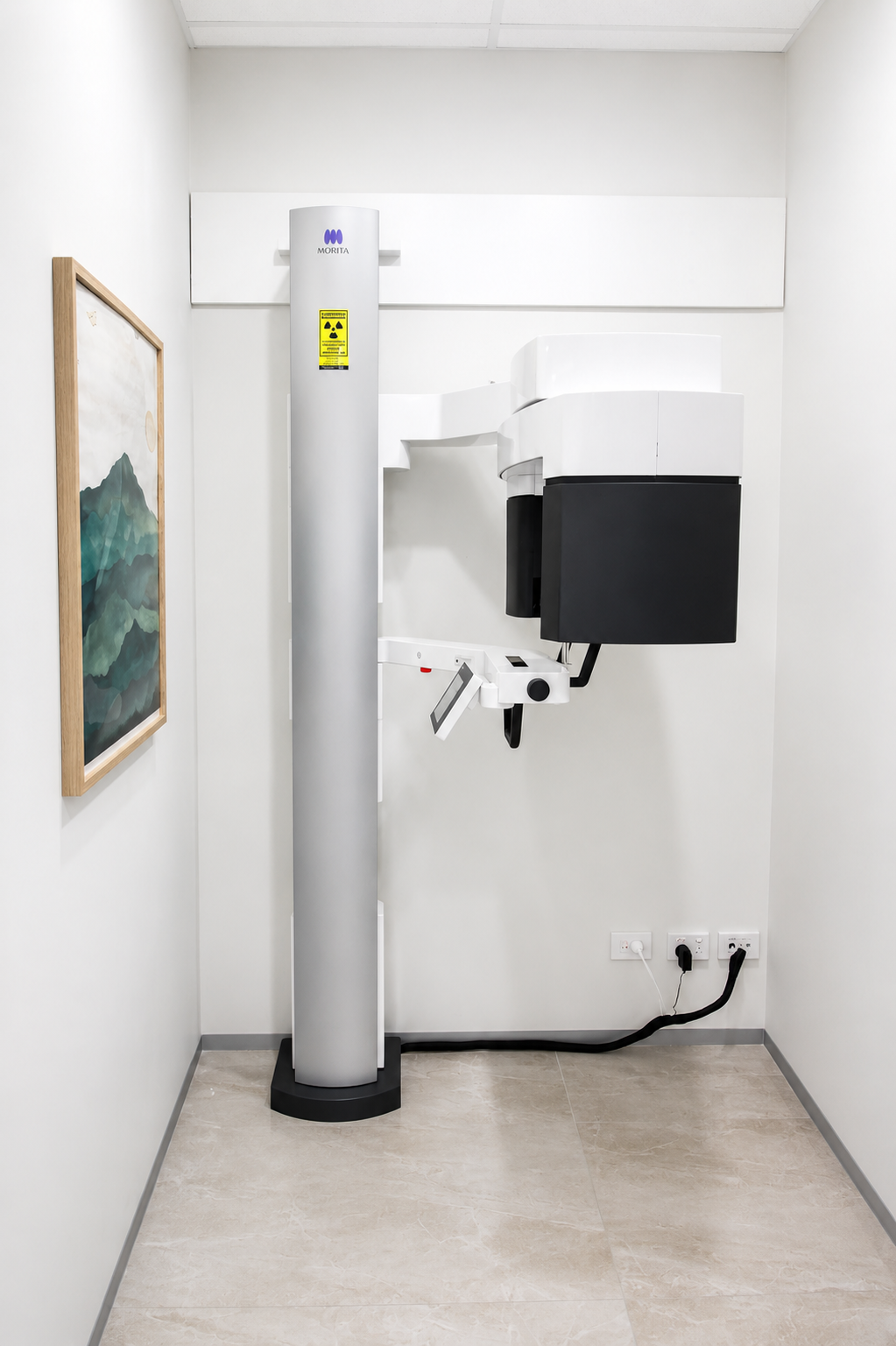
What is CBCT cone beam CT imaging?
Cone beam computed tomography (CBCT) is a three-dimensional digital imaging technology designed specifically for dental and maxillofacial structures. Where a conventional dental X-ray compresses the full three-dimensional anatomy of a tooth and its surrounding bone into a single flat image — losing critical information in the process — CBCT captures the entire volume of the region of interest and reconstructs it into axial, coronal, sagittal and three-dimensional views.
The technology uses a cone-shaped X-ray beam that rotates around the patient. A single rotation captures the complete dataset, which is then reconstructed into detailed 3D images available for review immediately after scanning. For endodontic applications we use small field of view settings — limiting the imaging volume to the area of clinical interest and minimising the radiation dose.
How CBCT transforms endodontic diagnosis
Standard two-dimensional periapical X-rays are an essential part of endodontic assessment — but they have fundamental limitations that can affect both diagnosis and treatment outcomes. The same structures that overlap and obscure each other on a flat X-ray are clearly separated and individually assessable in three dimensions.
Conventional 2D X-rays cannot reliably show:
- Additional or missed canals hidden behind other roots — a common finding in upper molars and premolars
- The true extent and direction of vertical root fractures — the single most important diagnosis in endodontics that changes the treatment plan from root canal to extraction
- The three-dimensional spread of internal or external root resorption
- The accurate size, shape and position of periapical lesions — which directly influences prognosis assessment
- The proximity of root apices to the inferior alveolar nerve or the floor of the maxillary sinus — critical information for surgical planning
- Whether a root perforation has occurred or where it is located
CBCT reveals all of this — substantially improving diagnostic accuracy and allowing more precise, better-planned treatment.
Clinical indications — when we use CBCT
Pre-treatment assessment of complex anatomy
- C-shaped canal systems, dens invaginatus, taurodontism, fused roots, or supernumerary roots
- Heavily calcified or obliterated canals where the root path cannot be confirmed on 2D imaging
- Suspected missed canals after previous root canal treatment where retreatment is being planned
Diagnosis of complex pathology
- Suspected vertical root fracture — the most critical indication; CBCT is the only reliable non-surgical diagnostic tool
- Differentiation of internal from external root resorption — these two conditions look similar on 2D X-ray but require completely different management
- Periapical pathology that is not visible or not adequately characterised on conventional imaging
- Referred dental pain with uncertain source despite thorough clinical examination
Dental trauma assessment
- Horizontal and vertical root fractures following trauma
- Extent of luxation injuries and associated alveolar bone damage
- Assessment of pulp space changes and root development status in young traumatised teeth
Surgical planning
All apical surgery cases at Southwest Endodontic Centre include CBCT assessment as standard. Surgical planning requires precise knowledge of root angulation, root length, bone thickness, proximity to the inferior alveolar nerve and maxillary sinus, and the exact position and size of the periapical lesion — information that cannot be obtained reliably from conventional X-rays.
Radiation safety — the facts
CBCT delivers significantly less radiation than a medical CT scan. To put the doses in context:
- Medical CT of the head: approximately 1,000–2,000 microsieverts (µSv)
- CBCT large field of view (full mouth): approximately 50–200 µSv
- CBCT small field of view (single tooth or quadrant): approximately 5–50 µSv
- Conventional periapical X-ray: approximately 1–8 µSv
For context, the dose from a small field of view CBCT is roughly equivalent to a few hours of background radiation that we are all exposed to naturally from the environment.
We use small field of view settings wherever clinically appropriate, limiting the imaging volume to the region of interest. We follow ALARA principles — As Low As Reasonably Achievable — and CBCT is only recommended when the diagnostic benefit clearly outweighs the radiation dose. We never take CBCT routinely or as a substitute for clinical examination.
CBCT reporting for referring dentists
Where CBCT is taken as part of your patient's assessment, your consultation report will include:
- Annotated CBCT images highlighting the relevant findings
- Written clinical interpretation of all findings and their significance
- A clear explanation of how CBCT findings influenced the diagnosis and treatment plan
- Specific anatomical measurements where relevant to surgical planning
Reports are sent electronically to your practice on the day of the appointment. If you would like to discuss CBCT findings by phone, we are always available to talk through cases before or after treatment.
CBCT at Southwest Endodontic Centre
CBCT 3D imaging is available at both of our practices — Southwest Endodontic Centre in Liverpool and Wollongong Endodontics. It is used as standard for all apical surgery cases, and whenever complex anatomy or an uncertain diagnosis warrants three-dimensional assessment.
CBCT works alongside the operating microscope as part of a comprehensive specialist service — giving our specialists the full diagnostic picture before any treatment begins.
Refer for CBCT-guided assessment
Complex anatomy, suspected fracture, unclear diagnosis or pre-surgical planning — call us to discuss or refer online.
Frequently asked questions
What is the difference between CBCT and a regular dental X-ray?
A regular dental X-ray is a two-dimensional image that compresses three-dimensional structures into a flat picture. CBCT captures a full three-dimensional volume of data, allowing us to view teeth, roots and surrounding bone from any angle and in any plane. This reveals anatomy that is simply invisible on conventional X-rays — including missed canals, root fractures, the true extent of resorption, and the precise relationship of roots to adjacent anatomical structures such as the inferior alveolar nerve and maxillary sinus.
Is CBCT safe? How much radiation does it involve?
Yes — CBCT is safe. The radiation dose from a small field of view CBCT (used for single tooth or quadrant assessment) is approximately 5–50 microsieverts — a fraction of a medical CT scan and comparable to a small number of conventional dental X-rays. We follow strict ALARA principles and only recommend CBCT when the clinical benefit clearly justifies the exposure.
Will I need CBCT for my root canal treatment?
Not necessarily. CBCT is recommended for specific clinical situations where conventional X-rays are insufficient — complex canal anatomy, suspected fractures, resorption, pre-surgical planning, and uncertain diagnoses. For straightforward root canal treatment, conventional digital X-rays are usually sufficient. Your specialist will advise whether CBCT is indicated for your specific case.
How long does a CBCT scan take?
The scan itself takes approximately 10–20 seconds. The full appointment including positioning and image review typically takes 15–20 minutes. Images are available for review immediately after the scan and annotated findings are included in the consultation report sent to your referring dentist on the same day.
Does CBCT cost extra?
CBCT may attract an additional fee where it is clinically indicated. This will always be discussed and agreed with you before the scan is taken — we never proceed with additional investigations without explaining why they are needed and what they will cost. Your specialist will explain exactly what diagnostic information the scan will provide.
When should I refer my patient for CBCT-guided endodontic assessment?
Consider referring for CBCT-guided assessment when you suspect: missed canals after previous treatment, vertical root fracture, root resorption, complex root anatomy preventing treatment completion, periapical pathology not explained by conventional X-ray findings, or when planning apical surgery. If in doubt, call us on (02) 9129 8806 to discuss — we are happy to advise by phone before you refer formally.