
What is endodontic retreatment?
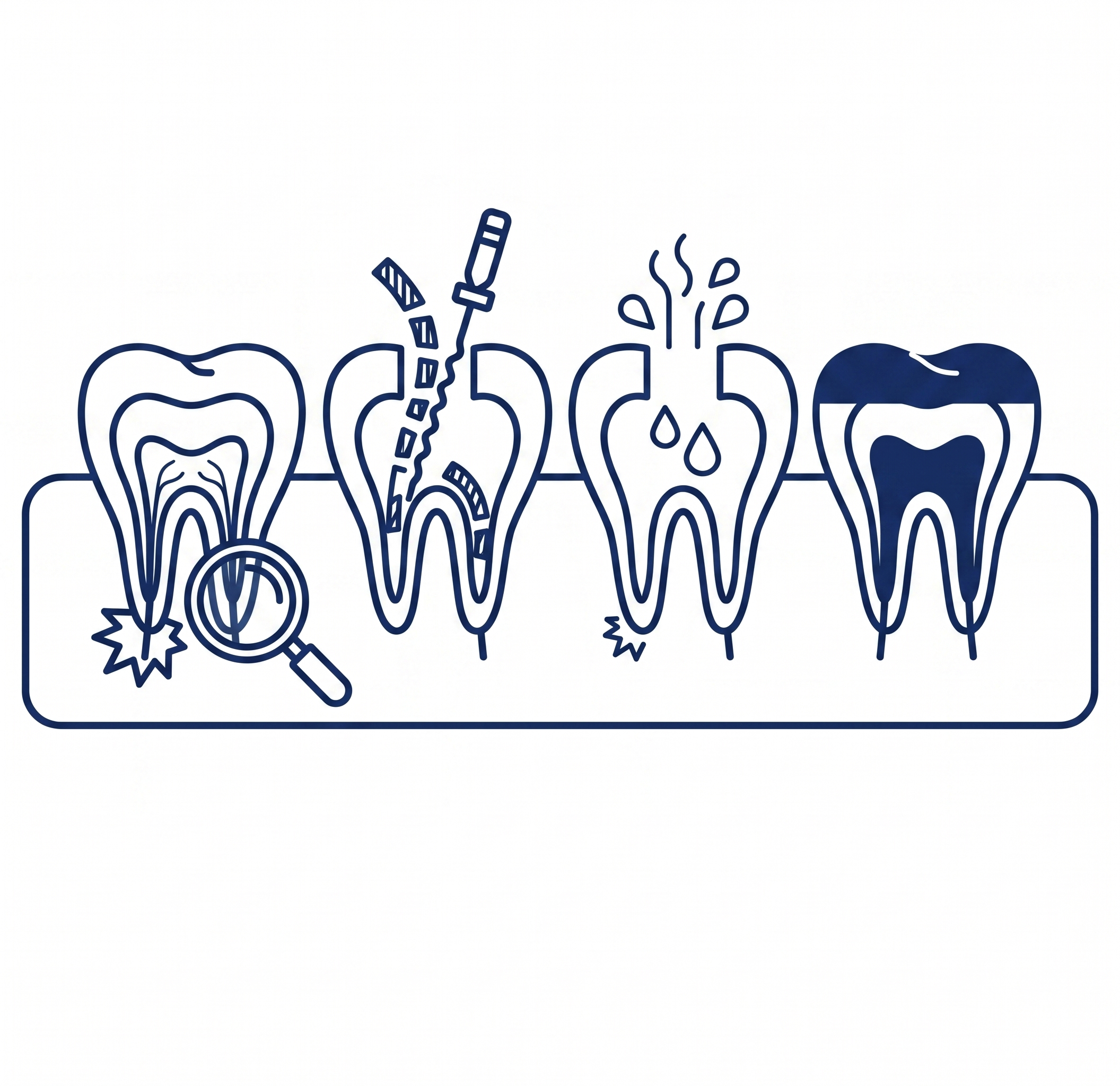
Endodontic retreatment is a second root canal procedure performed on a tooth that has already had root canal treatment but has developed new symptoms or shows signs of persistent or recurring infection on imaging. The procedure involves removing the existing root filling material, locating and cleaning any missed or inadequately treated canals, disinfecting the entire canal system, and re-sealing the tooth with modern bioceramic materials.
While most root canal treatments succeed long-term, a small percentage do fail — and when they do, retreatment by a specialist endodontist is the best chance of saving the tooth before resorting to extraction and implant replacement.
Why might a root canal fail?
Root canal failure is not always the result of poor treatment. The most common causes we see at our Liverpool practice include:
- Curved or narrow canals not fully treated initially — complex anatomy that general-practice instruments and magnification could not navigate completely.
- Complicated canals undetected — additional root canals (e.g. a second mesiobuccal canal in upper molars) that were missed without an operating microscope or CBCT.
- Crown or permanent restoration not placed in time — the temporary filling breaks down, allowing saliva and bacteria to re-enter the canal system from above.
- Saliva contamination — if the coronal seal is lost at any point after treatment, bacteria colonise the filled canals and cause reinfection.
- New decay exposing the root filling — a new cavity undermines the seal around the existing restoration and exposes the root canal filling to the oral environment.
- Cracked or loose crown — a failed crown allows microleakage along the margin, breaking the coronal seal and leading to reinfection of the root canal system.
Why retreatment needs a specialist endodontist
Retreatment is significantly more complex than initial root canal treatment. The specialist must remove gutta-percha and sealer that were placed during the original procedure, navigate past posts, cores, or separated instruments lodged in the canal, and identify anatomy that was missed the first time — all without weakening the remaining tooth structure. This demands the operating microscope, ultrasonics, specialised retreatment files, and the clinical judgement that comes from years of exclusively endodontic practice.
Published literature consistently shows that retreatment outcomes are better when performed by a specialist endodontist compared with general practice — particularly for teeth with posts, calcified canals, or separated instruments. A successful retreatment can add decades of life to a tooth that would otherwise require extraction.
Our retreatment approach
At Southwest Endodontic Centre, every retreatment case begins with a CBCT 3D scan to map the existing root filling, identify missed canals, and assess the condition of the periapical bone. Treatment is performed entirely under the operating microscope at up to 25× magnification.
After the old filling material is removed and the canals are re-shaped, the canal system is thoroughly disinfected with sodium hypochlorite and EDTA. Canals are then sealed with bioceramic materials — a modern alternative to traditional sealers that bonds chemically to dentine and provides a durable long-term seal.
Laser-assisted endodontic retreatment using the Fotona SkyPulse is available at our sister practice, Wollongong Endodontics →. If your patient would benefit from laser-assisted retreatment, please indicate this on the referral form and we can arrange an appointment at the Wollongong location.
What to expect
Retreatment typically requires two appointments of 60–90 minutes each, spaced approximately two weeks apart. At the first visit, the old filling material is removed and an antimicrobial medicament is placed inside the canals. At the second visit, the canals are re-cleaned and permanently sealed.
The procedure is performed under local anaesthetic and is no more uncomfortable than a standard root canal. Oral or IV sedation is available for anxious patients. Post-operative discomfort is typically mild and managed with paracetamol and ibuprofen for 2–3 days. You will return to your general dentist within four weeks for a new crown or permanent restoration.
Alternatives if retreatment is not possible
In some cases, retreatment may not be feasible — for example, if a post cannot be safely removed without risking root fracture, or if the canal is calcified beyond negotiation. When this occurs, we may recommend:
- Apical surgery (apicoectomy) — microsurgical access to the root tip, removal of infected tissue, and placement of a bioceramic root-end seal. Modern microsurgical techniques achieve 90%+ success rates.
- Extraction and implant replacement — the last resort when neither retreatment nor surgery can predictably save the tooth. We will always discuss this option honestly if it is the most appropriate path.
We never recommend treatment that is unlikely to succeed. If a tooth has a poor long-term prognosis, we will tell you — and your referring dentist — clearly and early.
Wollongong patients: Endodontic retreatment is also available at our sister practice, Wollongong Endodontics — the only specialist endodontic clinic in Wollongong.
Referring your patient for retreatment in Liverpool
If you have a patient with a failed root canal — persistent symptoms, radiolucency on imaging, or a new sinus tract — we encourage you to refer early. Early retreatment has a higher success rate than waiting until the tooth becomes symptomatic or the periapical lesion enlarges.
Use our online referral form and attach the original post-operative radiograph along with any current imaging. We will contact your patient within 24 hours and send you a full written report with microscope photographs after assessment. For complex cases, call (02) 9129 8806 and speak with one of our specialists directly.
Refer a Patient Online Why Refer to Us
Frequently Asked Questions
Endodontic retreatment is a second root canal procedure performed on a tooth that has already had root canal treatment but has failed — either due to persistent infection, new infection, or inadequate initial treatment. The previous root filling is removed, the canals are re-cleaned and re-shaped, and the tooth is re-sealed with modern bioceramic materials.
Common causes include curved or narrow canals that were not fully treated initially, complicated canal anatomy that was undetected without a microscope or CBCT, a crown or permanent restoration not placed in time allowing saliva contamination, new decay exposing the root filling to bacteria, and a cracked or loose crown breaking the coronal seal.
Yes. Retreatment is significantly more complex. The specialist must remove the previous root filling material, navigate past posts or separated instruments, identify canals that were missed the first time, and re-disinfect a canal system that has already been compromised. This is why retreatment should be performed by a specialist endodontist using a microscope and CBCT — not in general practice.
Specialist endodontic retreatment has a success rate of 70–85% depending on case complexity, the reason for failure, and the condition of the remaining tooth structure. Cases where the failure was caused by a missed canal or inadequate initial cleaning tend to have favourable retreatment outcomes.
If retreatment is not feasible, apical surgery (apicoectomy) may be recommended — accessing the root tip through a small incision, removing infected tissue, and sealing the root end with bioceramic material. If neither retreatment nor surgery is viable, extraction and implant replacement is the final option.
Use our online referral form and attach the original post-operative radiograph and any new imaging. We will contact your patient within 24 hours. For urgent cases, call (02) 9129 8806 directly.